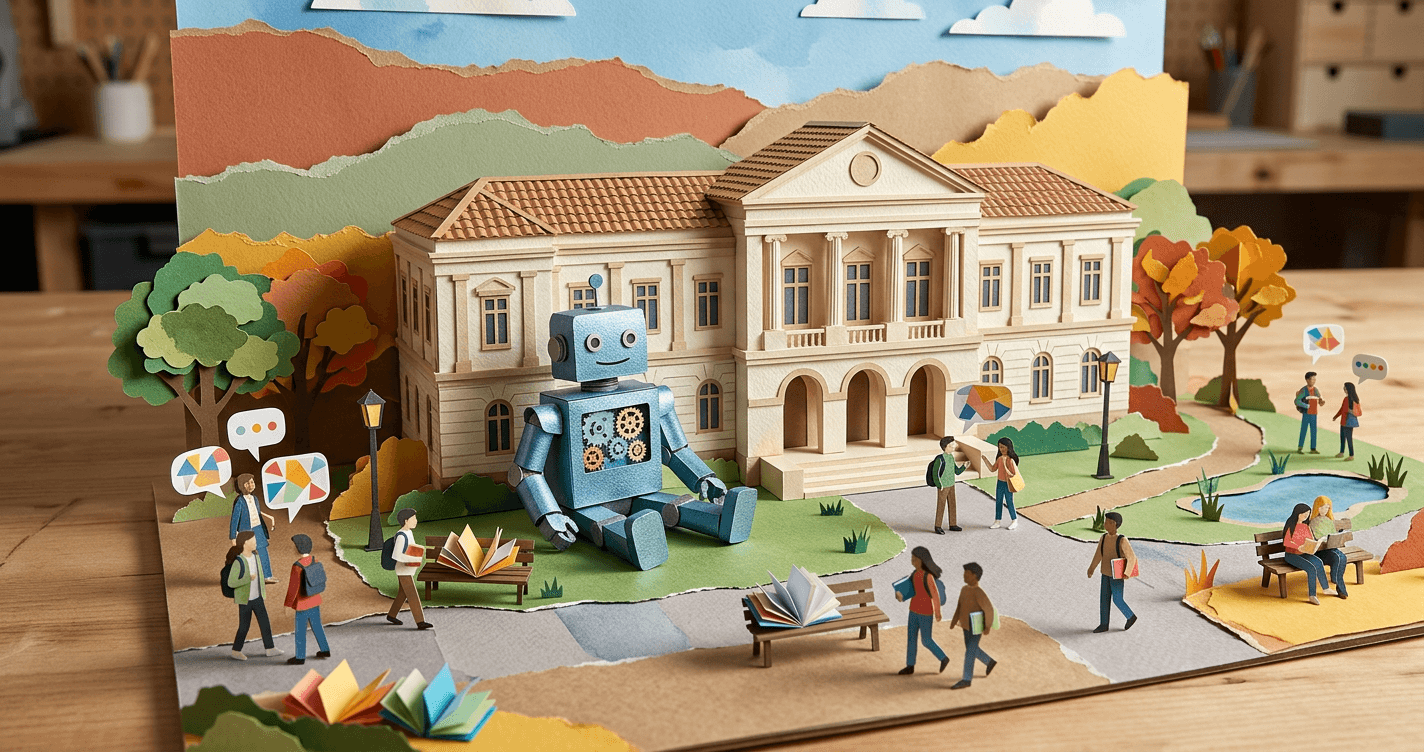
You're sitting in a 300-person lecture hall. The professor is three slides ahead of where your brain is. The student next to you seems to get it. You don't. You write down what's on the screen, tell yourself you'll figure it out later, and move on. Later turns into the night before the exam, and by then you're stacking confusion on top of confusion.
Now picture a different version of that same evening. Instead of staring at slides you half-understand, you have something that knows exactly which concepts you're shaky on, asks you targeted questions about them, explains your mistakes the moment you make them, and adapts in real time based on what you actually know. Not what a class average knows. What you know.
That's not a fantasy about some distant future. It's what AI-powered study tools are doing right now, and the research behind them goes back further than you might think. The shift isn't about replacing teachers or automating classrooms. It's about giving you, the student, access to the kind of learning experience that was once reserved for people who could afford a private tutor.
The 2-Sigma Problem: Why One-on-One Tutoring Works So Well
In 1984, educational psychologist Benjamin Bloom published a study that shook the education world. He found that students who received one-on-one tutoring performed two standard deviations better than students in a conventional classroom. That's enormous. It means the average tutored student outperformed 98% of students in a traditional lecture setting.
Bloom called this the 2-sigma problem: we know what works (personal tutoring), but we can't scale it. You can't put a private tutor in front of every student. Or at least, you couldn't.
Why Tutoring Works
One-on-one tutoring works because of three things: it meets you at your current level, it gives you immediate feedback when you're wrong, and it adjusts its approach based on how you respond. These are exactly the capabilities AI study tools are now replicating at scale.
Recent research from groups like the National Bureau of Economic Research (Korinek, 2023) suggests that large language models are beginning to approximate the benefits Bloom described. They're not perfect replacements for a skilled human tutor, but they're closing the gap faster than anyone expected. Students using AI tutoring tools show measurable gains in comprehension and retention, especially in subjects where they previously felt stuck.
The key insight isn't that AI is smart. It's that AI is patient. It will explain the same concept ten different ways without getting frustrated. It will catch your specific misunderstanding instead of delivering a one-size-fits-all explanation. And it's available at 2 AM, which is when a lot of real studying happens.
Real-Time Feedback Changes Everything
Think about the typical feedback cycle in a university course. You attend a lecture on Monday, do a problem set on Wednesday, submit it on Friday, and get it back (maybe) the following week. By the time you see what you got wrong, you've already moved on to new material. The mistake has had a week to solidify into a misconception.
This matters more than you might realize. John Hattie, whose meta-analyses synthesize over 1,800 studies on what affects student achievement, consistently ranks feedback as one of the most powerful influences on learning. But not just any feedback. The timing and specificity matter. Feedback that arrives immediately after a mistake is dramatically more effective than feedback delivered days later.
Hattie's Feedback Finding
Hattie's research shows feedback has an average effect size of 0.7, nearly double the 0.4 threshold he identifies as meaningful. But the effect depends heavily on timing. Immediate, corrective feedback while the task is still fresh produces the largest learning gains. Delayed feedback, like getting a graded paper back next week, has a much weaker effect.
AI study tools collapse this feedback gap to near zero. You solve a problem, and the tool tells you whether you're right or wrong within seconds. More importantly, good AI tools don't just say "incorrect." They explain why you're wrong and point you toward the specific concept you need to revisit. That's the difference between feedback that corrects and feedback that teaches.
This speed also changes your emotional relationship with mistakes. When you get feedback instantly, errors feel like part of the process. When you get feedback a week later, errors feel like failures. The faster the loop, the more willing you are to try, fail, and learn.
Why AI Study Tools Aren't Just "Googling It"
You might be thinking: I already have the internet. I can Google anything. Why do I need an AI study tool?
Fair question. Here's the difference. When you Google "Krebs cycle steps," you get a Wikipedia article, a YouTube video, and maybe a Quizlet set someone made three years ago. You read the answer. You feel like you learned it. You move on. That's passive exposure, and as decades of research on the testing effect (Roediger & Karpicke, 2006) show, passive exposure produces weak, short-lived memories.
AI study tools, when designed well, do something fundamentally different. They use retrieval practice: instead of showing you the answer, they ask you to produce it. They generate practice questions from your actual course material, quiz you on concepts you've studied, and track which ones you're getting wrong. The act of pulling information out of your head is what strengthens the memory, not reading someone else's explanation.
There's also the context problem. Google doesn't know what class you're taking, what your professor emphasized, or which chapters your exam covers. An AI study tool that works with your uploaded notes and slides does. It generates questions from your material, not a generic textbook summary. That context awareness is the difference between studying what you need to know and studying what the internet thinks is important.
The Familiarity Trap
Reading an answer on Google creates recognition: "Oh yeah, I've seen this." But exams test recall: "Write down what you know." These are different cognitive processes. Psychologists call the gap between them the fluency illusion. You feel like you know something because it looks familiar, but you can't actually produce it when the page is blank.
The Great Equalizer: Personalized Tutoring for Everyone
Here's something that doesn't get talked about enough: before AI study tools, the quality of your learning experience depended heavily on where you went to school and what you could afford. Students at well-funded universities had access to small tutorial groups, office hours with accessible professors, and supplemental instruction. Students at underfunded institutions or overcrowded programs often didn't.
Private tutoring made the gap even wider. A good tutor runs $40 to $100 an hour. Over a semester, that adds up to thousands of dollars that most students simply don't have. The result is a system where the students who need the most help have the least access to it.
AI study tools are changing this equation. An AI that can explain organic chemistry reaction mechanisms, quiz you on constitutional law, or walk you through a proof in linear algebra costs a fraction of what a human tutor charges. And it's available to every student, at every school, at any time. That's not a small thing.
Research from the Education Endowment Foundation consistently finds that technology-based interventions have the largest positive effects for students from disadvantaged backgrounds. When the playing field levels out, the students who were underserved benefit the most.
Access Changes Outcomes
The research on Bloom's 2-sigma problem showed that tutoring quality matters more than almost any other variable in education. AI doesn't fully replicate a master tutor yet. But it brings elements of that experience, including adaptive pacing, instant feedback, and personalized practice, to students who never had access to them before.
5 Ways to Use AI in Your Study Routine Tonight
You don't need to overhaul your entire approach. Start with one of these and see how it feels:
- Upload your lecture slides and generate practice questions. Instead of re-reading your notes, feed them to an AI tool and let it quiz you. The act of answering questions from memory is retrieval practice, and it's far more effective than passive review.
- Use AI to explain your mistakes, not just give you answers. When you get a practice problem wrong, don't just look up the solution. Ask the AI to explain why your approach was wrong and what concept you're missing. Understanding the why prevents the same mistake on the exam.
- Let spaced repetition scheduling do the planning. If your AI tool supports spaced repetition, let the algorithm decide what you review and when. It will prioritize the concepts you're weakest on and push mastered material further out. No more guessing about what to study tonight.
- Generate flashcards from your own material. Generic flashcard decks from the internet cover the wrong things in the wrong depth. AI-generated flashcards from your actual course content match what your professor will test you on, not what a random Quizlet user decided was important.
- Ask it to teach you like you're five. When a concept isn't clicking, ask the AI to simplify its explanation. Then ask it to give you an analogy. Then ask it to quiz you on the simplified version. Working from simple to complex is how understanding builds, and AI is endlessly patient with this process.
Start With One Subject
Don't try to AI-ify your entire study life in one night. Pick the subject you're struggling with the most. Upload your materials, generate a set of practice questions, and study them using retrieval practice. One focused session will show you whether this approach works for you.
How Studora Puts This All Together
Bloom showed that one-on-one tutoring produces a two standard deviation improvement. Hattie showed that immediate, specific feedback is one of the strongest influences on learning. Decades of research confirmed that retrieval practice and spaced repetition outperform every other study technique. The problem was never the science. It was access. Studora brings the core elements of personalized tutoring to every student, at a fraction of the cost.
- Personalized to your course, not a generic curriculum: Upload your lecture slides, PDFs, or notes, and Studora generates practice questions from that specific material. Like a tutor who has read your syllabus, it knows what your professor emphasizes and tests you on those concepts.
- Immediate feedback on every answer: When you get a question wrong, Studora explains why, using your own course materials as context. No waiting a week for a graded assignment. The feedback loop that Hattie's research identifies as critical happens in seconds, not days.
- Adaptive review scheduling: Cards you struggle with come back sooner. Topics you've mastered space out automatically. Studora adapts to your level the same way a good tutor would, focusing time on your weakest areas instead of reviewing what you already know.
- Available at 2 AM, endlessly patient: Like the AI tutoring tools that are closing the gap on Bloom's 2-sigma finding, Studora explains the same concept ten different ways without frustration. It meets you where you are, whenever you're ready to study.
The promise of AI in education was always personalized learning for everyone, not just students who can afford a private tutor. Studora is built to deliver on that promise.
The Bottom Line
AI isn't changing education by replacing teachers or automating grading. It's changing education by giving you direct access to personalized, feedback-rich, retrieval-based studying that used to require a private tutor. The research is consistent: immediate feedback, active recall, and spaced repetition are the most effective ways to learn. AI makes them all easier to do.
You don't need to wait for your school to adopt AI. You don't need permission from your professor. You just need to study differently tonight.
Your First Step
Pick one upcoming exam. Upload the lecture slides for the hardest topic to an AI study tool. Generate practice questions and quiz yourself without looking at your notes. That single session will teach you more than two hours of re-reading ever could. Try it tonight.
Further Reading
- Bloom (1984): The 2 Sigma Problem: The Search for Methods of Group Instruction as Effective as One-to-One Tutoring. The landmark study showing that one-on-one tutoring produces a two standard deviation improvement over conventional instruction.
- Dunlosky et al. (2013): Improving Students' Learning With Effective Learning Techniques. A comprehensive review rating ten study techniques by effectiveness. Practice testing and distributed practice rank highest.
- Roediger & Karpicke (2006): Test-Enhanced Learning. The foundational study on the testing effect, showing that retrieval practice produces superior long-term retention compared to repeated study.